
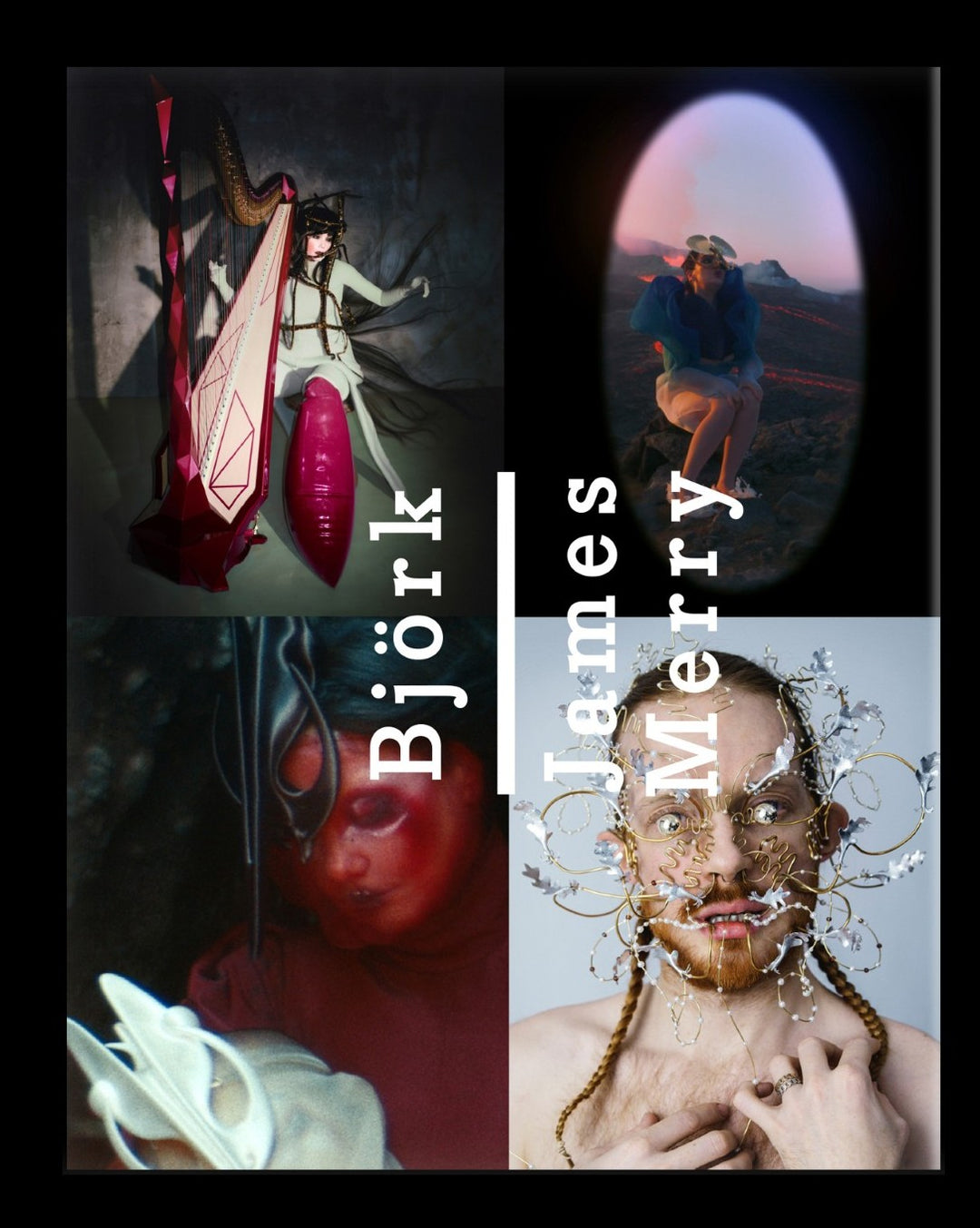
La Galerie nationale d’Islande publie un catalogue richement illustré, réalisé à l’occasion de deux expositions : Björk – Echolalia et James Merry – Metamorphlings, présentées au musée du 31 mai au 4 octobre 2026.
Il comprend une interview menée par l’écrivaine et poétesse Oddný Eir qui explore le croisement des collaborations créatives entre les deux artistes autour de la construction conceptuelle d’un « monde » dans les albums les plus récents de Björk.
interview en anglais
James Merry : I always found it funny when articles appeared online calling me "Björk’s mask-maker", because at first it was always just like this little side quest that I would do at night ... We were doing so many other things at the time, and we also lived together for long periods over the years... The masks emerged more like a bonus, an overnight fruit of our work together during that day. So, it never came from some burning desire to be a mask-maker ... More like a natural product of our friendship and working life.
Björk : We were in New York preparing the MoMA show with curator Klaus Biesenbach ... And I went downtown to a geological shop, found some rocks, and made very simple masks from them. I just put a rubber band on and fabricated it in a clumsy way. We were staying together, and then one morning, I came to the kitchen, and he was sitting there and had not slept at all, just been working on the Moth mask, doing what he thought I wanted to do but couldn’t do myself, so beautitul.
James Merry : I always found it funny when articles appeared online calling me "Björk’s mask-maker", because at first it was always just like this little side quest that I would do at night ... We were doing so many other things at the time, and we also lived together for long periods over the years... The masks emerged more like a bonus, an overnight fruit of our work together during that day. So, it never came from some burning desire to be a mask-maker ... More like a natural product of our friendship and working life.
Björk : We were in New York preparing the MoMA show with curator Klaus Biesenbach ... And I went downtown to a geological shop, found some rocks, and made very simple masks from them. I just put a rubber band on and fabricated it in a clumsy way. We were staying together, and then one morning, I came to the kitchen, and he was sitting there and had not slept at all, just been working on the Moth mask, doing what he thought I wanted to do but couldn’t do myself, so beautiful.
James Merry : It was the first live performance of Vulnicura, so there was this added pressure to really get it right... Then on the subsequent tour, it became this sort of game to try and make something new for each show with only a few days between. I remember when we were in Slovakia, she told me about this idea to have lines radiating from her vocal cords. I rushed out to a market and began pleating all this fabric I found using the tiny hotel iron, finishing it in a taxi on our way to the concert hall.
Björk : I remember when we were in a hotel in California and I shared with you the world of Utopia, flutes and animals in a very mutant energy, very sci-fi feeling, how optimism survives post-apocalyptic patriarchy ... I was talking about how the skin could bloom flowers and James went into a shop in Los Angeles and watched some DIY-videos and for two days he was making silicone plants in his bathtub, which he had never done before. And in this very glamorous hotel where Marilyn Monroe once stayed, you locked yourself in the bathroom day and night, endlessly experimenting.
It is maybe like this do-it-yourself style, but nobody would do it so beautifully as James, really high class.
And we would connect in this DIY. James comes from a home that is very DIY and our grassroots organization Smekkleysa/Bad taste is all about that, and based on the feeling that we’ve got everything we need, nothing is missing, nobody is specializing or stuck in one role, we just jump from one section to another to let things happen. Yes, we harmonize in that philosophy.
James Merry : I remember when Björk told me that embroidery was a strong textural element on her album Vulnicura, and I was immediately so excited about it. I had embroidered a bit in my twenties and thought, ok, perhaps this is somewhere | could finally contribute something with my own hands... of course, her instinct, it was the perfect way of dealing with the wound, stitching it together.
Björk : A heartbreak is such an extreme state. All you want is just to heal. I became obsessed with embroidery.
Sewing things together. My friend is going through a similar period now, and I just want to give her the secret code to go through the pain fast. The emergency in Vulnicura was expressed with neon yellow, and this lilac healing balm. The color lilac represents cure for me. And a big part of it was corresponding to the person I was breaking up with, this elevated elegance, like Victorian style ... You need to go to that level, to remember and then get over it, not to be stuck in the shit show in the basement. You need to get to a higher frequency. Also, because you have children, you don’t want the mess to land on them. You try to make a creative space.
James Merry : I’ve always enjoyed this vibrant period when you are in between album worlds ... When you haven’t completely defined where you’re going next, but there is often a sudden hunger for a color or texture that takes on a strange intensity for a brief period but does not then end up in the new album. Like the bright red you craved after Vulnicura, before you went into the peachiness of Utopia, and I put some red over the electric yellow masks from Vulnicura and made some other red masks for this time, to transition between worlds...
[..] I would say the masks are less about this Venetian carnival spirit, but more like a biological blurring between categories ... Between the technological and the handmade, plant and human, rock and animal, and whatever else, deliberately all smudged together a bit.
They were never meant to completely obscure Björk, more like to blur her edges and bring other archetypal aspects into focus. I think it taps more into this queer mentality meeting ecology-spirit.
Björk : I also feel that the representation of all genders the last few years is not a coincidence. We are harmonizing with our true nature. It’s not about whether I’m heterosexual or not, my work is quite queer and has always been. That’s my family tree, that’s my clan, you know. That’s the people who come to my shows. It’s also about this refusal to be categorized. And also all age groups, generations together and all kinds of music lovers, jazz listeners with others [...]. It’s also about the woman in the patriarchy, you go to the funeral as a widow with a black lace over your face, elegant but also in a punk fuck-it way, you cannot categorize me. Also, taking yourself off the heterosexual grid. Unclockable.
We were discussing the 20th century of Albert Einstein and the atoms, the cause and the effect. And now in the 21st century, we are discovering the magnetic energy, the solar winds, the hormonal system, all things magnetic that are more about vibration than the cause and effect of the elements on the periodic table. Now we are in quantum physics and biology, finally, my century ! We survived the 20th century, when the artist was a hero with a thousand assistants. Now we’re in a more matriarchal energy, with less hierarchy and more organic structure.
[..] What you describe makes me think about the possibility of being extroverted and introverted at the same time. The mask is like a tool for being extroverted when you’re in fact introverted, in situations where you have problems with communication, you don’t want to share this very personal thing, but you want to share something else, the essence of it. Then the mask is very empowering, like it escapes judgement, gives space for speculations before judgement.
When I was younger, I was never too self-conscious about the symbolic nature of my work ; it was simpler, like the pink and orange and techno-flowers world of the album Post, for example. It wasn’t until later that I became more self-conscious about it, after reading hundreds of psychology books. As a collaborator, it can be easier to use recognized words and concepts to explain and unify each album into a single world. Tell the sound engineers, photographers, video artists, and everyone the same story. I don’t have an ambition to become a visual artist ; it’s more that I am interpreting my music into a visual version, from the ear to the eye, like developing a film in support of sound. With motherly protection, I have formed a strong muscle to read my unborn album with closed eyes. Reading in the dark, you feel the shape of it, even if you cannot describe it yet with words. But when I manage to do that, without the ego, of course, it becomes something universal. We got such good feedback from Vulnicura, for example. It’s not about me anymore ; it’s like an emotional location or coordinate, which is psychologically true.
Sometimes the most abstract thing is the more autobiographical. Like when I got this energy meltdown in Australia, and | did those high-energy piano arrangements on my laptop. Suddenly I’m over-sharing the state of my fatigue with very fast piano music...
Sometimes it’s not in the lyrics.
James Merry : It’s like there is a little dynamo inside. And it is, of course, contradictory that, in hiding, you make yourself far more visible. The masks make you stand out much more. I think it’s that weird back-and-forth energy of hiding and revealing that gives a mask this power.
I’m so curious about your reaction towards people who have had that reaction to the masks, shouting at you to take off the mask, because they want to see your face.
Björk : For me, it is not so literal. I feel I’ve always tried to include both myself with and without masks. The theatrical and the casual. For example, when I DJ at the record shop Bad Tast, I am usually not wearing a mask, and I’m very close to people, so it’s not about hiding my face. But then, in the same month, for example, I will do a theatrical concert wearing a mask. I’ve always had both, hidden and not hidden.
***
Un essai de l’écrivain Hólmar Hólm revient sur l’évolution du travail artisanal et du design de Merry au cours de la dernière décennie, en s’intéressant aux origines et aux sources d’inspiration des significations que l’on peut trouver dans ses masques, ses ornements corporels et ses objets rituels.
Des extraits d’une conversation entre Björk et le poète Ocean Vuong offrent un aperçu de la manière dont la créativité permet d’explorer les profondeurs émotionnelles de la perte et du deuil. Une autre discussion, entre Björk et le commissaire d’exposition et historien de l’art Hans Ulrich Obrist, révèle et aborde l’étendue des différents médiums que Björk a explorés au fil du temps.

